
Prime Minister Narendra Modi will address the nation tonight at 8.30 PM, a day after a bill to implement women's reservation in legislatures was defeated in the Lok Sabha.
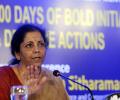
A high-level committee, including representatives from banks and payment associations, is set to decide on Merchant Discount Rate (MDR) for UPI transactions exceeding Rs 2,000 to merchants. While person-to-person and person-to-merchant transactions up to Rs 2,000 remain free, the move follows a recent amendment to the Payment and Settlement Systems Act, sparking debate and clarification from the Finance Minister that only certain high-value merchant transactions might incur charges.

A day before her scheduled appearance before the Enforcement Directorate in the Delhi excise policy case, Bharat Rashtra Samiti leader K Kavitha led a hunger strike here on Friday seeking the passage of the long-pending Women's Reservation Bill in this Budget session of Parliament.

NDA leaders have defended proposed amendments to the Women's Reservation Act and the Delimitation Bill, 2026, arguing women have waited long enough for reservation, while opposition parties allege the process could undermine India's federal and democratic structure, particularly impacting southern states.

The Congress on Monday said it welcomed the reported move as the party has been raising the demand for long.

The Indian government has mandated that banks and payment providers cannot levy charges on UPI transactions up to Rs 2,000 or on payments made via RuPay debit cards. This directive follows an amendment to the Payment and Settlement Systems Act, 2007, aiming to sustain and expand the digital payments ecosystem.

Prime Minister Narendra Modi has accused opposition parties of obstructing the passage of the women's reservation bill in Parliament, alleging they have crushed the dreams of women and prioritised selfish politics over national progress.

A Constitution Amendment Bill aimed at implementing 33 per cent reservation for women in legislatures and increasing Lok Sabha seats was defeated in Parliament, marking a setback for the government's efforts to empower women in politics.

Congress general secretary Jairam Ramesh has alleged that the BJP's "real and ultimate target" in seeking a two-thirds majority in the Lok Sabha is to amend the Constitution to end reservation, rather than genuinely implement women's reservation.

The Lok Sabha is set to expand to 815 seats, with 272 seats reserved for women, according to Union Law Minister Arjun Ram Meghwal. The move aims to implement the women's quota without disadvantaging men or any state. The proposed legislations also include provisions for reservation for women from SC and ST categories within the women's quota.

The opposition on Tuesday termed as an 'election jumla' the women's reservation bill brought by the government with many leaders raising questions over the proposed legislation, contending it doesn't account for reservation for OBC communities and that it will be effective at the earliest by the 2029 Lok Sabha polls.

While the BJP and the Congress have always supported the bill, opposition by other parties and demands from some for quota for backward classes within the women's quota have been key sticking points.

Prime Minister Narendra Modi appealed to Lok Sabha members to vote for the women's reservation bill, emphasising the need to empower women and rectify decades of political inaction.

The Indian government has introduced a 0.4% Merchant Discount Rate (MDR) on UPI person-to-merchant (P2M) transactions exceeding Rs 2,000, effective October 15. This move ends nearly six years of fully free UPI payments, though person-to-person (P2P) transfers and small P2M payments remain free. The charges aim to bolster investment in UPI infrastructure, with specific exemptions and caps for essential sectors.

Home Minister Amit Shah has offered to hold a comprehensive debate in Parliament on student protests and other pressing issues, but Congress leader Rahul Gandhi has swiftly rejected the proposal, demanding accountability for actions against students.

'The reason why they rushed through the bill was they wanted to avoid using the 2026 Census because the 2026 Census by their own decision will be a caste census.' 'The BJP knows that a significant share of the OBCs who will get captured in the census, for the first time after the 1931 Census, are against the BJP. Only a segment of the OBCs are in their favour.' 'So they wanted to avoid the OBC reservation among women, which is a demand of a lot of Opposition parties.'

Tamil Nadu Chief Minister M K Stalin celebrated the defeat of the Constitution Amendment Bill in the Lok Sabha, emphasising the unity of the south and the triumph of democracy. The bill aimed to implement reservation for women in legislatures in 2029 and increase Lok Sabha seats. Stalin criticised the bill as weakening the balance of the union and asserted Tamil Nadu's commitment to justice, dignity, and federalism.

TMC MP Mahua Moitra has written to Lok Sabha Speaker Om Birla, seeking his intervention after she was allegedly forced to vacate a circuit house in Nadia district, claiming harassment and threatening legal action. She reported a crowd shouting 'Jai Shree Ram' slogans outside the premises after her refusal to leave.

The National Payments Corporation of India (NPCI) stated that the Merchant Discount Rate (MDR) "is distributed only amongst the UPI ecosystem, to further invest into infrastructure resilience, innovation, cybersecurity (protecting the UPI infrastructure with banks and non-banks) and customer service."

The government is introducing a 0.4% Merchant Discount Rate (MDR) on UPI person-to-merchant payments above Rs 2,000, effective October 15. This move ends the zero-MDR regime, aiming to fund UPI infrastructure and sustainability, as the previous government subsidy was insufficient to cover operational costs. Payments between individuals and most everyday merchant transactions will remain free.
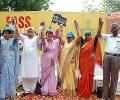
The distance between Rajya Sabha and the Lok Sabha can be covered in less than 15 minutes, so why has the women's reservation bill been stranded in the middle? asked Communist Party of India-Marxist leader Brinda Karat in a rally cum public meet in New Delhi on Thursday.

According to a bulletin issued on Wednesday, 'The Constitution (One Hundred and Thirty-First Amendment) Bill, 2026', 'The Delimitation Bill, 2026' and 'The Union Territories Laws (Amendment Bill), 2026' will be introduced and debated for passage in the Lower House.

It is curtains for the much-talked about Women's Reservation Bill, at least for the time being. While the 14th Lok Sabha has just concluded its last session, the parliamentary standing committee examining the women's reservation bill has now got one more extension to complete its task.

The Women's Reservation Act 2023, mandating 33 per cent quota for women in legislatures, has been enacted, but its immediate implementation is unclear due to ongoing parliamentary debates and delimitation requirements.

Sonia Gandhi criticises the government's proposed delimitation, claiming it's a politically motivated move to delay the caste census and gain an unfair advantage, rather than genuinely promoting women's reservation.

Prime Minister Narendra Modi on Friday expressed concern over the repeated disruptions of parliamentary proceedings, stating that due to the turmoil in the House, the country has been unable to listen to the talented MPs elected in recent times.

The BJP has issued a three-line whip to its MPs, requiring their presence during the extended Budget session of Parliament, where amendments to the Women's Reservation Act are expected to be considered.

Women politicians bring to politics and policy a sensitivity that most of their male counterparts, at least until a generation back, lacked.

The Indian government is reportedly developing new proposals to increase Lok Sabha seats by 50 per cent across all states. This initiative aims to address concerns from southern states regarding potential political power reduction due to population-based delimitation, while also facilitating the operationalisation of the women's quota law before the 2029 Lok Sabha elections.
The Samajwadi Party, RJD and some other parties do not favour the bill in its present form.

Several opposition parties on Wednesday decided to jointly oppose the delimitation provisions in the Constitution amendment bill in Parliament, even as they reiterated support for women's reservation, with Mallikarjun Kharge alleging the move is politically motivated.

With the three-day special sitting of Parliament on the constitution amendment bill related to the implementation of 33 percent reservation for women from the 2029 Lok Sabha polls set to begin on Thursday, a meeting of opposition parties is slated to be held on Wednesday at the residence of Congress president Mallikarjun Kharge.

The Congress party in Haryana boycotted a special session of the state assembly, accusing the ruling BJP of using the platform for political propaganda related to a defeated Constitution amendment bill on women's reservation. The BJP criticised the Congress's move as anti-women.
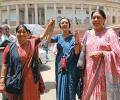
A rediff.com ready reckoner on the controversial Bill

Actor-MP Kangana Ranaut and movie legend Sharmila Tagore are embroiled in a public debate over Vande Mataram.
The Payments Council of India has confirmed that Unified Payments Interface (UPI) services will continue to be free for consumers and small merchants, despite a recent Lok Sabha Bill. This clarification addresses concerns about potential charges, emphasising that while a sustainable financial model for UPI infrastructure is being developed, transaction charges will not be passed on to users or small businesses.

'The made-up stories really angered me. Forget angering me, it actually made me feel, okay, if they want to play this game, let me play along.'

As more opposition MPs are now aligning with the ruling NDA, sources in the government indicated that possibilities are being explored to give a fresh push to the delimitation legislation in Parliament.
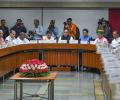
The bill seeks to reserve one-third of all seats for women in the Lok Sabha and the state legislative assemblies.

He claimed that out of 90 secretaries of the government of India, only three are from the Other Backward Classes and control only five per cent of the Budget, which he said was an "insult" to the backward classes.
